
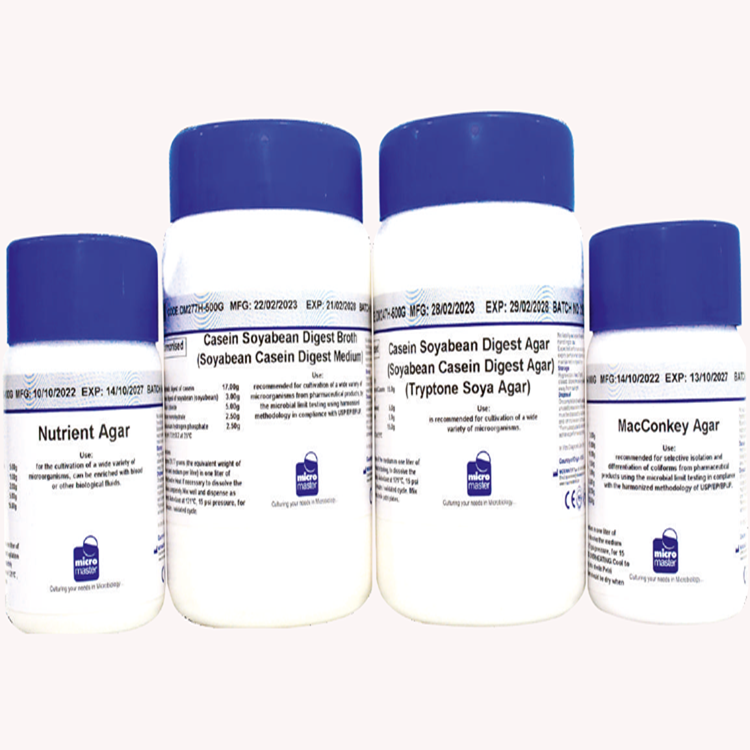
Peptone Salt Solution-0.1%
Pack Size: 500gm
Brand: Micro Master
Origin: India
Intended Use
Peptone Salt Solution-0.1% (DM1834) is recommended for use as diluent for different test methods.
Product Summary and Explanation
0.1% Peptone Salt solution is recommended as a diluent for dilution of sample by different test methods widely used for examination of foodstuffs. Standard methods for the examination of foodstuffs require sample dilution to be carried out accurately for enumerating the microorganisms. This medium is also recommended by ISO Committee(1) for use as an isotonic diluent as it ensures recovery of organisms from various sources which may be vulnerable in distilled water or aqueous suspensions.
Principles of the Procedure
0.1% Peptone Salt solution contains peptone at low concentration which provides nutrients for survival of microorganisms and hence protecting the organisms.(2) Also, it does not cause multiplication of the organisms within 45 minutes (at 20-25°C) of dilution of the sample. Sodium chloride at 0.85% concentration maintains osmotic balance of medium thereby maintaining cell morphology and integrity.(3) The pH of this diluent medium is near neutral range optimum for viability of microorganisms. Therefore it can be successfully used as a diluent for carrying out dilutions of different samples.
Formula / Liter
| Ingredients | : Gms / Liter |
| Bacteriological Peptone | : 1.00 |
| Sodium chloride | : 8.50 |
| Final pH: 7.0 ± 0.2 at 25°C | |
| Formula may be adjusted and/or supplemented as required to meet performance specifications | |
Precautions
1. For Laboratory Use only.
2. IRRITANT. Irritating to eyes, respiratory system, and skin.
Directions
1. Suspend 9.5 grams of the medium in one liter of distilled water.
2. Heat if necessary to dissolve the medium completely.
3. Autoclave at 121°C, 15 psi pressure, for 15 minutes / validated cycle.
Quality Control Specifications
| Dehydrated Appearance | : Off white to yellow homogeneous free flowing powder | |
| Prepared Medium | : Cream to pale yellow clear solution in tubes | |
| Reaction of 0.95% Solution | : pH: 7.0 ± 0.2 at 25°C | |
| Gel Strength | : Not Applicable | |
Expected Cultural Response: Cultural characteristics observed on Soyabean Casein Digest Agar (DM247), after an incubation at 35-37°C for 18-48 hours of cultures suspended in 0.1% Peptone Salt solution for 30 minutes.
| Sr. No. |
Organisms | Results to be achieved | |
| Inoculum(CFU) | Recovery(after 30 minutes) | ||
| 1. | Escherichia coli ATCC 25922 | 50-100 | no change in numbers |
| 2. | Staphylococcus aureus ATCC 25923 | 50-100 | no change in numbers |
The organisms listed are the minimum that should be used for quality control testing.
Test Procedure
1. Distribute 10 gm of test sample along with 90 ml of 0.1% Peptone salt solution for enumeration.
2. Blend the prepared dilution at 15,000 to 20,000 revolutions per minute.
3. Further prepare a tenfold dilution using 1 ml of it in 9ml of sterile diluent within 15 minutes and mixed well. This is considered as 10-1 dilution.
4. Prepare sequential dilutions using same diluent and counts obtained by spread plate or pour plate technique.
5. Tests may be performed in duplicates as described in technique and checked for equivalent yields of organisms between the diluent batches.
6. Incubate the tubes with test organisms.
7. At time of zero minutes and after 30 minutes and 2 hours, subculture an inoculums (approximately 0.01ml) or a loop full onto Soyabean Casein Digest Agar (DM247) using streak plate technique.
8. If desired SCDA may be also enriched with 5% v/v sheep blood depending on intended organisms to be isolated. Incubate plates at 35±2ºC for 18-24 hours.
9. Refer appropriate references for specific test procedures.
Results
Refer appropriate references and test procedures for interpretation of results.
Storage
Store the sealed bottle containing the dehydrated medium at 2-30°C. Once opened and recapped, place container in a low humidity environment at the same storage temperature. Protect from moisture and light.
Expiration
Refer to the expiration date stamped on the container. The dehydrated medium should be discarded if not free flowing, or if the appearance has changed from the original color. Expiry applies to medium in its intact container when stored as directed.
Limitations of the Procedure
1. For identification, organisms must be in pure culture. Morphological, biochemical and/or serological tests should be performed for final identification.
2. Consult appropriate texts for detailed information and recommended procedures.
Related products


Top rated products
-
 Analytical Balance, 0.01/0.1mg - 52/120g, OHAUS, USA
984,802.00৳
Analytical Balance, 0.01/0.1mg - 52/120g, OHAUS, USA
984,802.00৳
-
 Vertebral Column with Pelvis and Painted Muscles
-
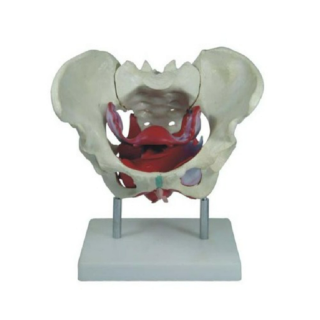 Female Pelvic Muscles and Organs
-
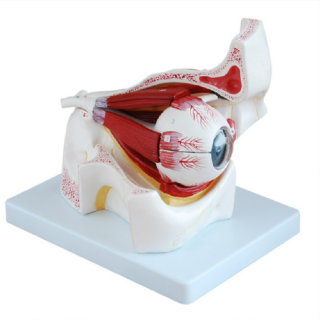 Eye with Orbit
-
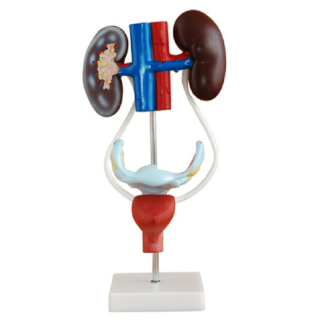 Female Urogenital System
-
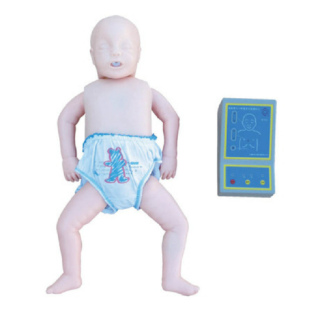 Infant CPR Training Manikin
-
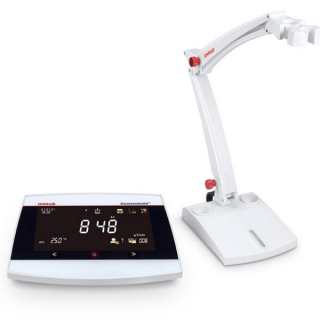 pH Meter, Bench Type, OHAUS, USA
173,264.00৳
pH Meter, Bench Type, OHAUS, USA
173,264.00৳
-
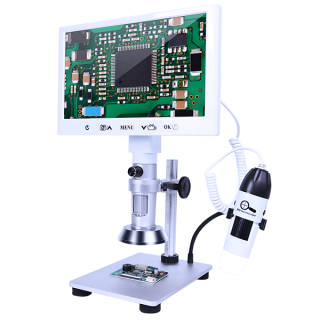 7" LCD Mono Zoom+ USB Portable Dual Lens Digital Microscope, 2.0M+1.3M
-
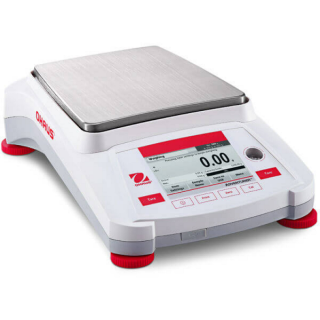 Precision Balance, 0.1 g - 8,200 g, OHAUS, USA
560,560.00৳
Precision Balance, 0.1 g - 8,200 g, OHAUS, USA
560,560.00৳
-
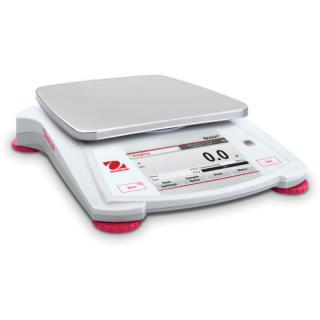 Portable Balance, 0.1 g - 2,200 g, OHAUS, USA
165,620.00৳
Portable Balance, 0.1 g - 2,200 g, OHAUS, USA
165,620.00৳
Reviews
There are no reviews yet.