
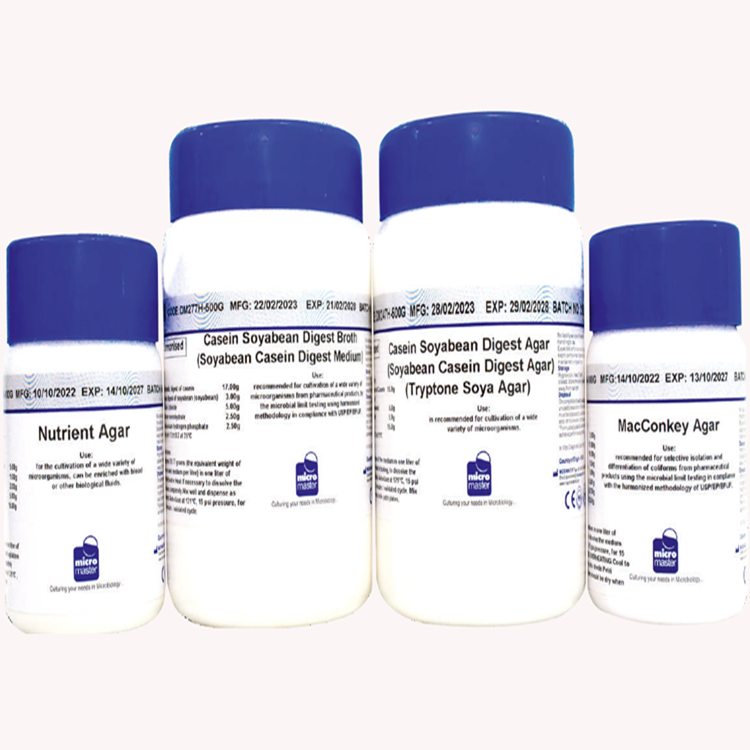
Cetrimide Agar
Pack Size: 500gm
Brand: Micro Master
Origin: India
Intended Use
Cetrimide Agar (DM057B) is recommended as a selective medium for the isolation of Pseudomonas aeruginosa from pharmaceutical products in compliance with BP.
Product Summary and Explanation
Pseudomonas aeruginosa is a gram-negative, aerobic bacterium which grows well on all normal laboratory media but specific isolation of the organism, from environmental sites or from human, animal or plant sources, is best carried out on a medium, which contains a selective agent and also constituents to enhance pigment production. Most selective media depend upon the intrinsic resistance of the species to various antibacterial agents. King et al.(1) developed the formulation of Cetrimide Agar. This media is based on the formulation described in BP(2) and is in accordance with the harmonized method of BP/EP/USP/JP/IP.(2,3,4,5,6) It is used as a selective medium for the isolation of Pseudomonas aeruginosa from pharmaceutical products. In 1951, Lowbury(7) described the use of 0.1% cetrimide in a selective medium for P. aeruginosa. Because of the increased purity of the inhibitory agent, the concentration was later reduced, as reported by Lowbury and Collins in 1955.(8)
Cetrimide is a quaternary ammonium salt, which acts as a cationic detergent that reduces surface tension in the point of contact and has precipitant, complexing and denaturing effects on bacterial membrane proteins. It exhibits inhibitory actions on a wide variety of microorganisms including Pseudomonas species, whilst allowing Pseudomonas aeruginosa to develop typical colonies. Brown and Lowbury employed incubation at 37°C with examination after 18 and 42 hours of incubation.(9)
P.aeruginosa can be identified due to their characteristic production of pyocyanin, a blue, water-soluble, non-fluorescent phenazine pigment coupled with their colonial morphology and the characteristic grape-like odor of aminoacetophenone.(10) P.aeruginosa is the only species of Pseudomonas or gram-negative rod known to excrete pyocyanin. These media are therefore, important in the identification of P.aeruginosa.
Principles of the Procedure
Cetrimide Agar contains pancreatic digest of gelatin which supplies the nutrients necessary to support growth of the organisms. The production of pyocyanin a blue-green pigment is stimulated by the magnesium chloride and dipotassium sulfate in the medium, which improves detection of Pseudomonas on this medium. Presence of magnesium ions can also neutralize EDTA, if present in the sample. Cetrimide is a quaternary ammonium, cationic detergent compound, which is inhibitory to a wide variety of bacterial species other than P. aeruginosa. Cetrimide causes nitrogen and phosphorus to be released from bacterial cells other than Pseudomonas aeruginosa. Cetrimide Agar is supplemented with 1% glycerol as a source of carbon for growing cells.
Formula / Liter
| Ingredients | : Gms / Liter |
| Pancreatic digest of gelatin | : 20.00 |
| Magnesium chloride | : 1.40 |
| Dipotassium sulphate | : 10.00 |
| Cetrimide | : 0.30 |
| Agar | : 13.60 |
| Final pH: 7.2 ± 0.2 at 25°C | |
| Formula may be adjusted and/or supplemented as required to meet performance specifications | |
Precautions
1. For Laboratory Use only.
2. IRRITANT. Irritating to eyes, respiratory system, and skin.
Directions
1. Suspend 45.3 grams of medium in one liter of distilled water water containing 10 ml glycerol.
2. Heat to boiling, to dissolve the medium completely.
3. Autoclave at 121°C, 15 psi pressure, for 15 minutes / validated cycle.
Quality Control Specifications
| Dehydrated Appearance | : Cream to yellow homogeneous free flowing powder | |
| Prepared Medium | : Light amber coloured opalescent gel with a slight precipitate forms in Petri plates | |
| Reaction of % Solution | : Not Applicable | |
| Gel Strength | : Firm, comparable with 1.36% Agar gel | |
Growth Promotion Test
Growth Promotion is carried out in accordance with the method of BP. Cultural response was observed after an incubation at 30-35°C for specified time. Recovery rate is considered as 100% for bacteria growth on Soybean Casein Digest Agar.
Growth promoting properties
Growth of microorganism comparable to that previously obtained with previously tested and approved lot of medium occurs at the specified temperature for not more than the shortest period of time specified inoculating <=100 cfu (at 30-35°C for <=18 hours).
Inhibitory properties
No growth of the test microorganism occurs for the specified temp for not less than longest period of time specified inoculating >=100 cfu (at least 100 cfu) (at 30-35°C for >= 72 hours).
Expected Cultural Response: Cultural characteristics observed after incubation at 30-35°C for 18-72 hours. Recovery rate is considered as 100% for bacteria growth on Soyabean Casein Digest Agar.
| Sr. No. |
Organisms | Results to be achieved | |||||
| Inoculum (CFU) |
Growth | Observed Lot value (CFU) |
Recovery | Incubation Temperature & Time |
|||
| Growth promoting | |||||||
| 1. | Pseudomonas aeruginosa ATCC 9027 |
50-100 | good-luxuriant | 25-100 | >=50% | 30-35°C <=18 hrs |
|
| Inhibitory | |||||||
| 2. | Escherichia coli ATCC 8739 | >=10³ | inhibited | 0 | 0% | 30-35°C >=72 hrs |
|
| Additional Microbiological testing | |||||||
| 3. | Pseudomonas aeruginosa ATCC 27853 |
50-100 | good-luxuriant | 25-100 | >=50% | 30-35°C 18-24 hrs |
|
| 4. | Pseudomonas aeruginosa ATCC 25668 |
50-100 | good-luxuriant | 25-100 | >=50% | 30-35°C 18-24 hrs |
|
| 5. | Stenotrophomonas maltophila ATCC 13637 |
>=10³ | inhibited | 0 | 0% | 30-35°C >=72 hrs |
|
| 6. | Escherichia coli ATCC 25922 | >=10³ | inhibited | 0 | 0% | 30-35°C >=72 hrs |
|
| 7. | Escherichia coli NCTC 9002 | >=10³ | inhibited | 0 | 0% | 30-35°C >=72 hrs |
|
| 8. | Staphylococcus aureus ATCC 6538 |
>=10³ | inhibited | 0 | 0% | 30-35°C >=72 hrs |
|
| 9. | Staphylococcus aureus ATCC 25923 |
>=10³ | inhibited | 0 | 0% | 30-35°C >=72 hrs |
|
| 10. | Salmonella typhimurium ATCC 14028 |
>=10³ | inhibited | 0 | 0% | 30-35°C >=72 hrs |
|
| 11. | Proteus mirabilis ATCC 29906 | >=10³ | inhibited | 0 | 0% | 30-35°C >=72 hrs |
|
The organisms listed are the minimum that should be used for quality control testing.
Test Procedure
1. For the isolation of P.aeruginosa, plates of Cetrimide Agar should be inoculated from non-selective medium such as Soybean Casein Digest Medium (DM277B).
2. If the count is high, the test sample can be directly inoculated onto Cetrimide Agar.
3. Refer to appropriate references for standard test procedures.
Results
1. Colonies that are surrounded by a blue-green pigment and fluoresce under short wavelength (254 nm) ultraviolet light may be presumptively identified as Pseudomonas aeruginosa.
2. Note, however, that certain strains of P. aeruginosa may not produce pyocyanin.
3. Other species of Pseudomonas do not produce pyocyanin, but fluoresce under UV light.
4. Most non-Pseudomonas species are inhibited, and some species of Pseudomonas may also be inhibited.
5. Gram staining, biochemical tests and serological procedures should be performed to confirm findings.
6. Refer to appropriate references and standard test procedures for interpretation of results.
Storage
Store the sealed bottle containing the dehydrated medium at 10-30°C. Once opened and recapped, place container in a low humidity environment at the same storage temperature. Protect from moisture and light.
Expiration
Refer to the expiration date stamped on the container. The dehydrated medium should be discarded if not free flowing, or if the appearance has changed from the original color. Expiry applies to medium in its intact container when stored as directed.
Limitations of the Procedure
1. Pseudomonas aeruginosa colonies may appear pigmented greenish (under UV light also). Addition of nalidixic acid can aid in inhibiting the growth of accompanying flora.
2. For identification, organisms must be in pure culture. Morphological, biochemical and/or serological tests should be performed for final identification.
3. Consult appropriate texts for detailed information and recommended procedures.
Related products


Top rated products
-
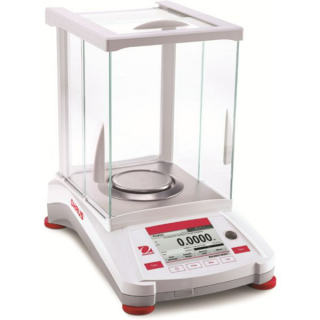 Analytical Balance, 0.1mg - 120g, OHAUS, USA
৳ 838,292.00
Analytical Balance, 0.1mg - 120g, OHAUS, USA
৳ 838,292.00
-
 Deluxe Life-Size Skull Style D
-
 Life-Size Hand Joint with Ligaments
-
 Middle Ear Model
-
 Expansion Model of Urinary Bladder
-
 Advanced Artificial Abortion Simulated Uterus
-
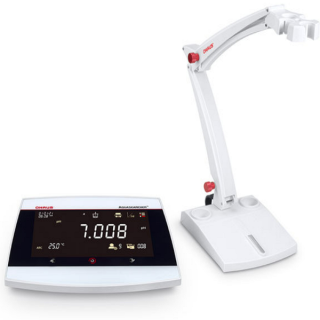 pH Meter, Bench Type, OHAUS, USA
৳ 229,320.00
pH Meter, Bench Type, OHAUS, USA
৳ 229,320.00
-
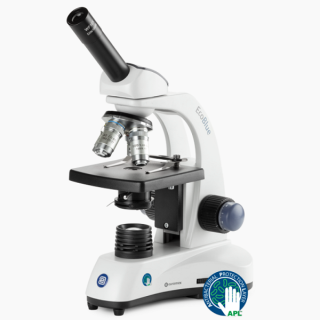 Monocular Microscope
-
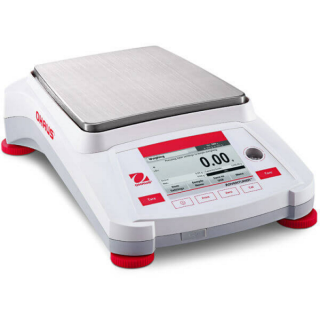 Precision Balance, 0.01 g - 420 g, OHAUS, USA
৳ 445,900.00
Precision Balance, 0.01 g - 420 g, OHAUS, USA
৳ 445,900.00
-
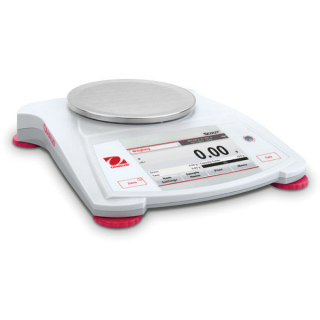 Portable Balance, 0.01 g - 420 g, OHAUS, USA
৳ 200,018.00
Portable Balance, 0.01 g - 420 g, OHAUS, USA
৳ 200,018.00
Reviews
There are no reviews yet.