
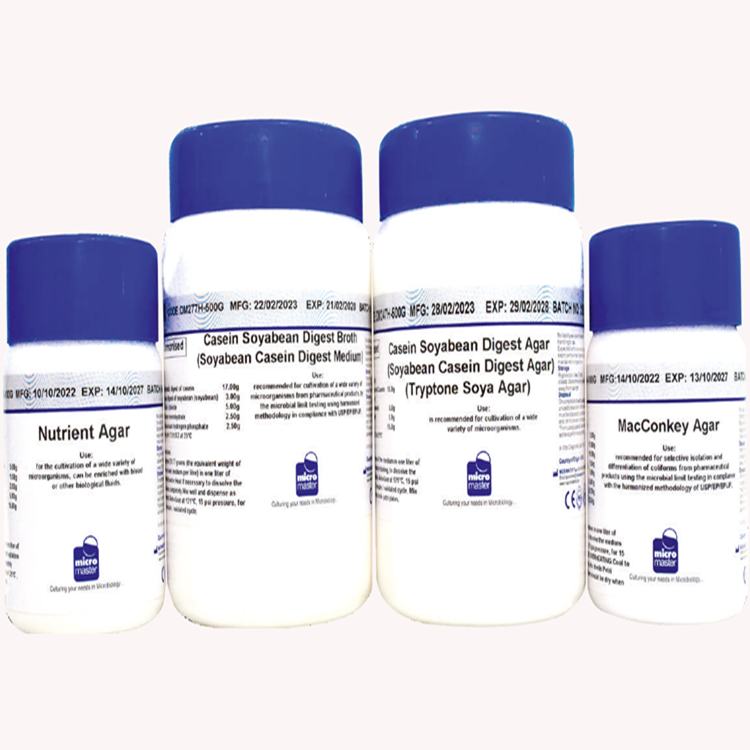
Skim Milk Agar
Pack Size: 500gm
Brand: Micro Master
Origin: India
Intended Use
Skim Milk Agar (DM613) is recommended for cultivation and enumeration of microorganisms encountered in dairy industry.
Product Summary and Explanation
Skim Milk is soluble, spray-dried skim milk. When prepared in a 10% solution, it is equivalent to fresh skim milk. Skim Milk is sometimes used as a complete medium or as an ingredient in other media used for propagation of organisms occuring in milk products like Mycobacterium tuberculosis, Corynebacterium diphtheriae etc. Skim Milk is used for differentiating organisms based on coagulation and proteolysis of casein in foods(1) and dairy products.(2) Addition of skim milk to any nutrient-rich medium creates favourable conditions for growth of organisms, which are encountered in milk. The number of bacteria isolated thus is more than the number of organisms isolated on a regular medium.(3) Proteolytic bacteria hydrolyze casein to form soluble nitrogenous compounds indicated as clear zone surrounding the colonies on the agar medium. More clear zones are seen on milk agar if, the bacteria produce acid from fermentable carbohydrates in the medium.
Skim Milk Agar is used for the demonstration of coagulation and proteolysis of casein.(4) The medium is recommended by APHA(5) for cultivation and enumeration of microorganisms encountered in dairy industry.(6)
Principles of the Procedure
Skim Milk Agar contains casein enzymic hydrolysate which provides amino acids and other complex nitrogenous substances. Yeast extract supplies vitamin B complex. Addition of skim milk in the medium makes the conditions optimal for microorganisms encountered in milk; it is a source of lactose and casein and other growth nutrients. Dextrose acts as the carbon and energy source.
Formula / Liter
| Ingredients | : Gms / Liter |
| Part A | |
| Casein enzymic hydrolysate | : 5.00 |
| Yeast extract | : 2.50 |
| Dextrose | : 1.00 |
| Agar | : 15.00 |
| Part B | |
| Skim milk powder | : 28.00 |
| Final pH: 7.0 ± 0.2 | |
| Formula may be adjusted and/or supplemented as required to meet performance specifications | |
Precautions
1. For Laboratory Use only.
2. IRRITANT. Irritating to eyes, respiratory system, and skin.
Directions
1. Prepare Part A and Part B separately.
2. Suspend 23.5 grams of Part A in 500ml distilled water. Heat to boiling to dissolve the medium completely. Sterilize
3. Suspend 28g of Part B in 500ml distilled water separately. Gently heat to dissolve completely. Do not autoclave/Overheat as Part B is heat sensitive. Autoclave/heated at 100°C for 10min.
4. Mix well and pour into sterile petri plates.
Quality Control Specifications
| Dehydrated Appearance | : Cream to yellow homogeneous free flowing powder |
| Prepared Medium | : Off white coloured opaque gel forms in petri plates |
| Reaction of 5.15% Solution | : pH 7.0 + 0.2°C |
| Gel Strength | : Firm, comparable with 1.5% Agar gel |
Expected Cultural Response: Cultural characteristics observed after an incubation at 35-37°C for 18-24 hours.
| Sr. No. |
Organisms | Results to be achieved | |||
| Inoculum (CFU) |
Growth | Recovery | Proteolytic activity | ||
| 1. | Bacillus subtilis ATCC 6633 |
50-100 | good-luxuriant | >=70% | positive reaction, clear zone surrounding colonies |
| 2. | Enterococcus faecalis ATCC 29212 |
50-100 | good-luxuriant | >=70% | negative reaction, no clear zone surrounding colonies |
| 3. | Escherichia coli ATCC 25922 |
50-100 | good-luxuriant | >=70% | negative reaction, no clear zone surrounding colonies |
| 4. | Proteus mirabilis ATCC 25933 |
50-100 | good-luxuriant | >=70% | positive reaction, clear zone surrounding colonies |
| 5. | Pseudomonas aeruginosa ATCC 27853 |
50-100 | good-luxuriant | >=70% | positive reaction, clear zone surrounding colonies |
| 6. | Serratia marcescens ATCC 8100 |
50-100 | good-luxuriant | >=70% | positive reaction, clear zone surrounding colonies |
The organisms listed are the minimum that should be used for quality control testing.
Test Procedure
Refer to appropriate references for standard test procedures.
Results
Refer to appropriate references and standard procedures for interpretation results.
Storage
Store the sealed bottle containing the dehydrated medium at 10-30°C. Once opened and recapped, place container in a low humidity environment at the same storage temperature. Protect from moisture and light.
Expiration
Refer to the expiration date stamped on the container. The dehydrated medium should be discarded if not free flowing, or if the appearance has changed from the original color. Expiry applies to medium in its intact container when stored as directed.
Limitations of the Procedure
1. Skim Milk supports the growth of many microorganisms.
2. For identification, organisms must be in pure culture. Morphological, biochemical and/or serological tests should be performed for final identification.
3. Consult appropriate texts for detailed information and recommended procedures.
Related products


Top rated products
-
 Tracheostomy Simulator
-
 Comprehensive Surgical Skills Training Model
-
 Acupuncture Model 46CM Male
-
 HD-3 Portable Thickness Tester For Capsule
-
 Dual Channel Thermometer - TM-925
-
 Bismuth Sulphite Agar
-
 Milk Agar
-
 Buffered Sodium Chloride-Peptone Solution pH 7.0 (Pack of 9ml x 25 bottles)
-
 Cobalt for AA
-
 Lead for ICP
Reviews
There are no reviews yet.